
RESEARCH NOTE · VISA (V) AND MASTERCARD (MA)
Visa and Mastercard Data Leak: How Stocks Have Reacted to Cyber Incidents
Information cutoff: Thursday night, November 19. Prices are through the Thursday, November 19 close.
On Thursday, Nov. 19, The Wall Street Journal reported that hackers had leaked customer data from Visa, Mastercard and JPMorgan Chase, and all three companies said outside companies that work for them had been hit by cyber incidents.12 A ransomware group calling itself n0n claimed all three companies as victims on its leak site and posted sample data, according to the security firm SOCRadar, which said it had not independently verified the claim.2
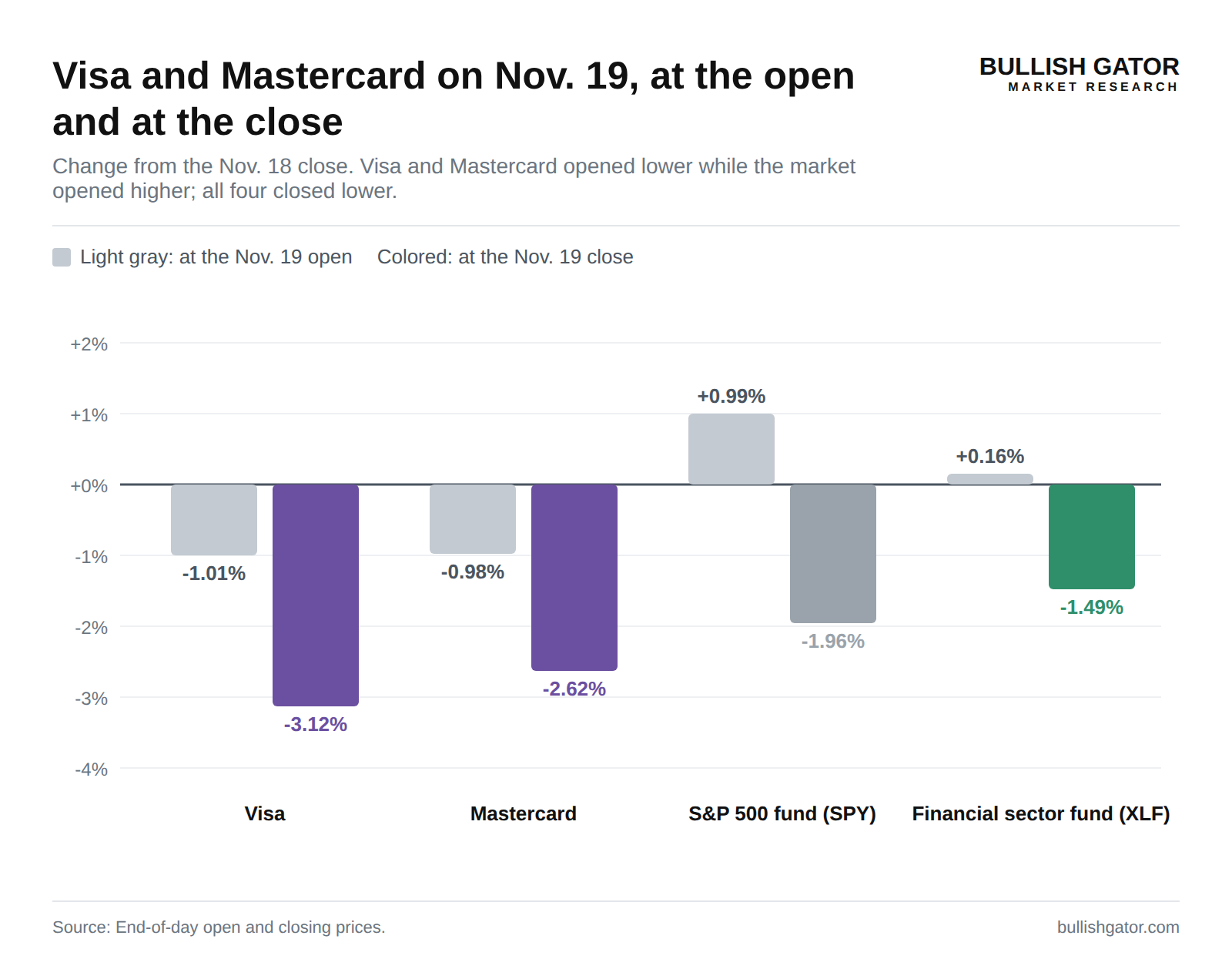
Both stocks fell more than the market. Visa closed at $402.25, down 3.12%, and Mastercard closed at $626.50, down 2.62%, while the S&P 500 fund (SPY) fell 1.96%. That left Visa 1.16 percentage points behind the market for the day and Mastercard 0.66 points behind.4 To put those moves in context, this note looks at the cyber incidents that companies we cover have disclosed in SEC Form 8-K filings since the SEC’s incident rule took effect in December 2023, and at how each stock moved against the market afterward.
What the companies said
Chase said in a post on X that third parties providing services to the bank “were the target of a cyber attack,” adding: “Based on our investigation so far, we believe the attackers accessed certain marketing data held by those vendors, which may include some customer names and email addresses.” The bank said its services were not disrupted, that the attack was not connected to a service disruption some customers had earlier in the week, and that it would offer affected customers complimentary credit monitoring where appropriate.2
A Visa spokesperson said Visa’s incident involved a third-party service provider in the Asia Pacific region: “Visa’s systems were not involved and were not impacted. No payments data such as card numbers were affected.” A Mastercard spokesperson said an incident at a third-party provider exposed a limited number of email addresses belonging to a “small subset” of cardholders enrolled in a benefit program, that the exposure had been contained, and that “there is no impact to the Mastercard payment network or the ability for people to use their cards.”2
None of the three companies named the vendors or said how many customers were affected.12 The Independent reported that the leaked records appear to be mostly email addresses of Chase customers and some bank employees, with phone numbers in some cases, covering accounts that number in the thousands.3 The leak followed a week of outages that the companies involved said were not cyberattacks, including the Microsoft 365 outage on Nov. 12 and 13 and a Chase service disruption on Monday that the bank blamed on a software bug.2 As of Thursday night, neither Visa nor Mastercard had filed an 8-K about the incident.10
How Visa and Mastercard make money, and what’s new
Visa and Mastercard run the networks that move card payments between banks, merchants and cardholders. Visa’s net revenue for the fiscal year ended Sept. 30 was $45.9 billion, up 15%, which the company attributed to growth in payments volume, cross-border volume and processed transactions. By line, service revenue was $19.9 billion, data processing revenue $23.4 billion, international transaction revenue $15.3 billion and other revenue $5.7 billion, less $18.3 billion of incentives paid to clients.5 Mastercard’s third-quarter net revenue rose 14% to $9.8 billion: payment network revenue grew 11%, and value-added services and solutions grew 19%.6 Our Mastercard vs. Visa Breakdown from Oct. 22 compares the two businesses in more detail.
Visa is adding to its fraud-prevention business. On Aug. 3, it agreed to buy BioCatch, a fraud-intelligence provider, for $2.4 billion in cash, a deal it expects to close by the end of its fiscal second quarter of 2027, and CEO Ryan McInerney said in October that “trust is the next growth vector for Visa.”5 Mastercard CEO Michael Miebach’s October remarks focused on agentic commerce and the company’s new Global Money Platform through BVNK.6 The companies said Thursday’s incidents involved outside providers rather than their payment networks; Mastercard confirmed limited email-address exposure, while Visa said its systems were not involved and no payments data was affected.2
What 24 cyber disclosures show
Since Dec. 18, 2023, public companies have had to report a cybersecurity incident they judge material under Item 1.05 of Form 8-K, generally within four business days of deciding it is material.7 In May 2024, the SEC’s Division of Corporation Finance encouraged companies to report incidents they had not judged material under a different item, such as Item 8.01.8 We searched the SEC’s filing records for both kinds of disclosure by the 444 companies we cover and found 24 incidents at 22 companies, filed from January 2024 through October 2026. For each one, we compared the stock’s return with SPY’s on the first trading day the market could react to the company’s first 8-K, and over the first five trading days. Amgen and Quest Diagnostics reported quarterly results within two days of their filings, so they are left out of the averages.
The typical first-day reaction was small. Across the other 22 incidents, the median stock trailed SPY by 0.93 percentage points on day one, and 14 of the 22 trailed. That is about the size of an ordinary day: for the companies in this study, the median daily gap with SPY, up or down, was 0.92 points from January 2024 through Nov. 19. After five trading days, the median stock was 0.99 points behind the market, with 13 of 22 trailing.410
When operations stop, the losses run deeper
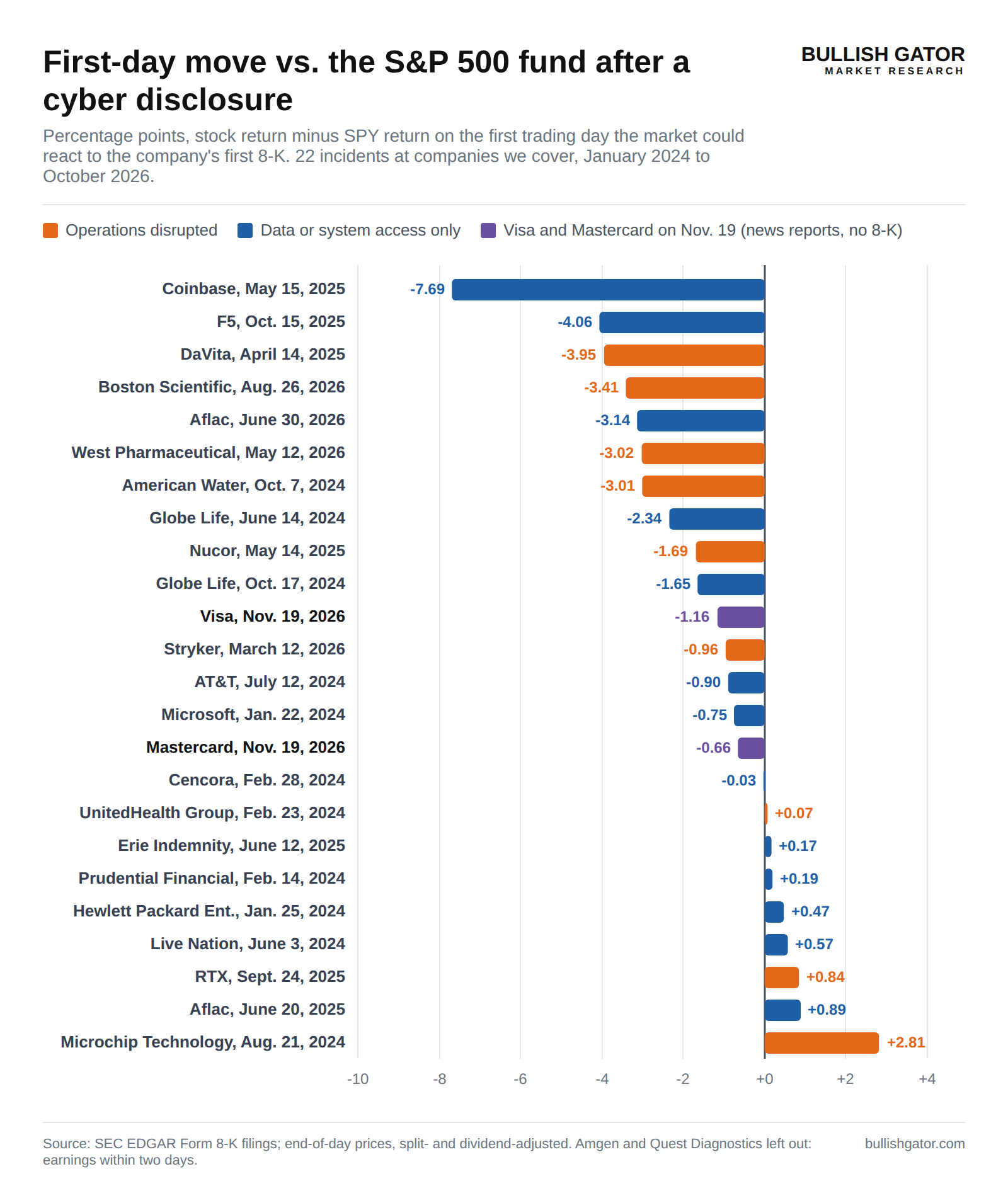
The difference that stood out was whether the company’s first filing described a disruption to its operations. In the nine incidents where it did, such as DaVita’s ransomware attack, Nucor’s halt of some production and Boston Scientific’s global disruption, the median stock trailed SPY by 1.69 points on day one and by 3.69 points after five days, with six of the nine behind. In the 13 incidents limited to stolen data or system access, the median stock was 0.75 points behind on day one and 0.23 points behind after five days.410
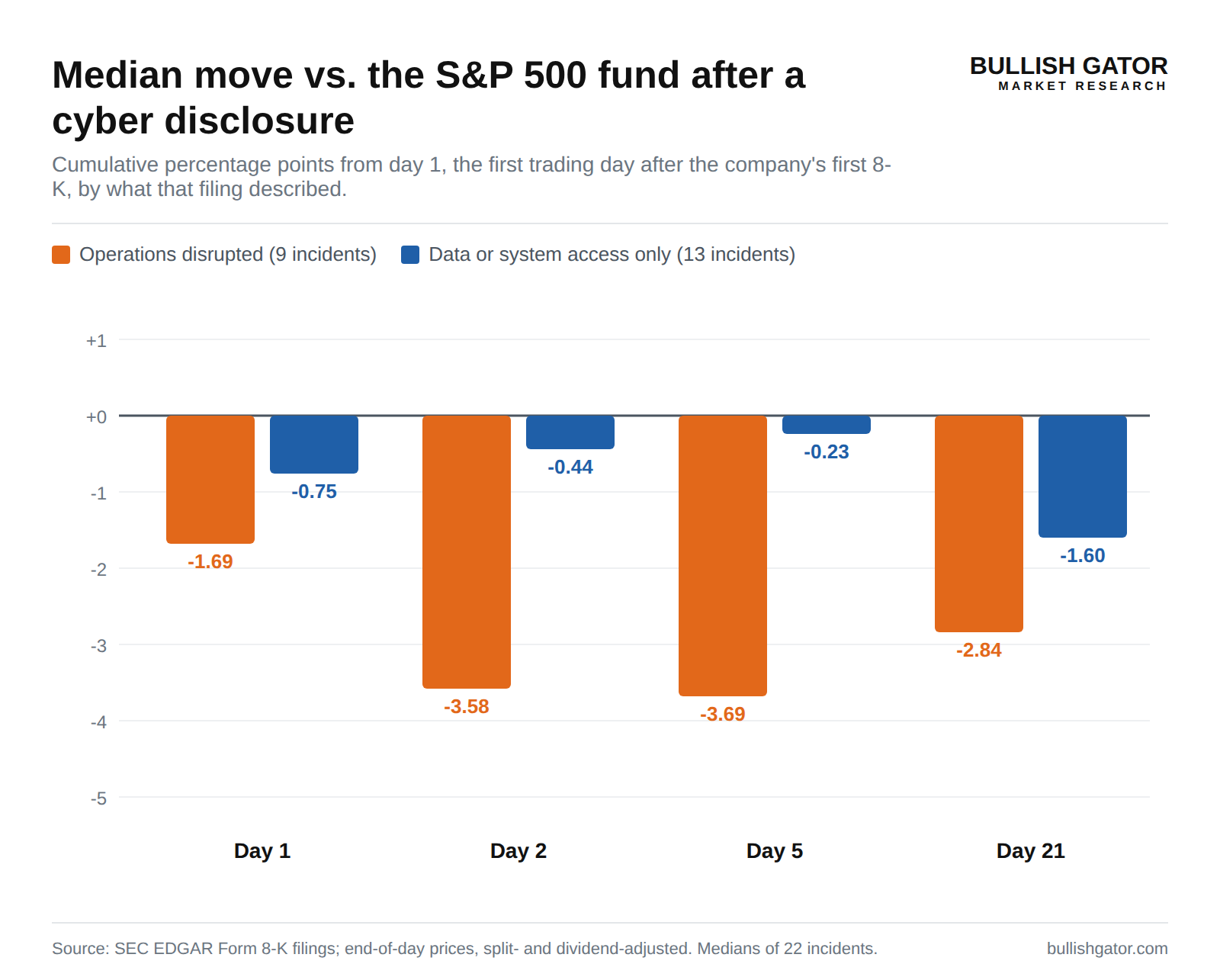
DaVita fell 2.98% on April 14, 2025, the morning it disclosed a ransomware attack that encrypted parts of its network, and trailed SPY by 11.23 points over five days. Boston Scientific, which said the incident hurt its ability to process and ship customer orders, trailed by 3.41 points on Aug. 26, 2026, and by 7.18 points over two days. West Pharmaceutical Services trailed by 3.02 points on its first day, then said on May 20 that it was fully operational and that the incident was not reasonably likely to have a material impact on its 2026 second-quarter and full-year financial guidance.41012 Two operational cases went the other way: Microchip Technology beat SPY by 2.81 points on its first day, and RTX, whose ransomware incident hit airport check-in software that its filing said runs outside the company’s own network, beat SPY by 0.84 points.10
| Operations disrupted | First 8-K | Day 1 vs. SPY | 5 days vs. SPY |
|---|---|---|---|
| UnitedHealth Group Attackers got into Change Healthcare systems, which were isolated, disrupting its services. | Feb. 22, 2024 | +0.07 | -6.49 |
| Microchip Technology An intruder disrupted servers; some plants ran below normal and order fulfillment was impacted. | Aug. 20, 2024 | +2.81 | +1.02 |
| American Water Works Unauthorized network activity led it to disconnect some systems; water facilities were not affected. | Oct. 7, 2024 | -3.01 | -3.69 |
| DaVita Ransomware encrypted parts of the network and impacted some operations. | April 14, 2025 | -3.95 | -11.23 |
| Nucor Unauthorized access led it to halt some production as a precaution. | May 14, 2025 | -1.69 | -4.38 |
| RTX Ransomware hit Collins airport check-in software; airlines saw delays and cancellations. | Sept. 24, 2025 | +0.84 | +3.73 |
| Stryker An incident caused a global disruption to its Microsoft environment. | March 11, 2026 | -0.96 | +2.31 |
| West Pharmaceutical Services Ransomware: data taken, systems encrypted and operations disrupted globally. | May 11, 2026 | -3.02 | -5.53 |
| Boston Scientific An incident disrupted operations globally, including processing and shipping orders. | Aug. 26, 2026 | -3.41 | -2.94 |
Percentage points: the stock’s return minus SPY’s return on the first trading day the market could react to the company’s first 8-K (day 1), and summed over the first five trading days. Dates are filing dates and link to the filings; day 1 is the next trading day when a filing came after the close, so the chart’s dates can be a day later.410
The data incidents that still hurt
Most data incidents barely moved the stocks. The two biggest exceptions came with a direct cost or damage to the product. Coinbase said bribed support staff overseas had taken customer data for an attacker who then demanded money, and it estimated expenses of about $180 million to $400 million for remediation and voluntary customer reimbursements. The stock trailed SPY by 7.69 points that day, although it had gained 26.38 points more than SPY over the three sessions before.49
F5 said a nation-state attacker with long-term access had taken parts of the source code for its BIG-IP products, along with information about vulnerabilities it was working on. The stock fell 3.62% on the disclosure day and 10.70% the next day. When F5 reported results on Oct. 27, 2025, it guided to fiscal 2026 revenue growth of 0% to 4%, saying it expected some near-term disruption to sales cycles as customers assessed and remediated their environments after the incident, and the shares fell 7.86% the next day.411
| Data or system access only | First 8-K | Day 1 vs. SPY | 5 days vs. SPY |
|---|---|---|---|
| Microsoft A nation-state actor accessed a small percentage of employee email accounts, including senior leaders. | Jan. 19, 2024 | -0.75 | +0.29 |
| Hewlett Packard Enterprise A nation-state actor took data from a small percentage of cloud email mailboxes. | Jan. 24, 2024 | +0.47 | -2.45 |
| Prudential Financial A threat actor accessed administrative and user data and some employee and contractor accounts. | Feb. 13, 2024 | +0.19 | +2.88 |
| Cencora Data, some possibly personal information, was taken from its information systems. | Feb. 27, 2024 | -0.03 | -0.56 |
| Live Nation Entertainment Unauthorized activity in a third-party cloud database, mainly Ticketmaster data later offered for sale. | May 31, 2024 | +0.57 | -4.71 |
| Globe Life A web-portal access flaw likely exposed consumer and policyholder information. | June 14, 2024 | -2.34 | +3.51 |
| AT&T Call and text records of nearly all wireless customers were copied from a third-party cloud workspace. | July 12, 2024 | -0.90 | +2.23 |
| Globe Life An extortion attempt involving data on about 5,000 people. | Oct. 17, 2024 | -1.65 | +0.75 |
| Coinbase Bribed overseas support staff took customer data; the attacker demanded money. | May 15, 2025 | -7.69 | -0.23 |
| Erie Indemnity Unusual network activity it called an information security event. | June 11, 2025 | +0.17 | -1.66 |
| Aflac Unauthorized network access, contained within hours; files held personal and claims data. | June 20, 2025 | +0.89 | -1.42 |
| F5 A nation-state actor with long-term access took BIG-IP source code and vulnerability information. | Oct. 15, 2025 | -4.06 | -14.36 |
| Aflac Aflac Japan systems were accessed; files held policy and bank account details. | June 30, 2026 | -3.14 | +0.32 |
| Amgen† Data, including patient health information, was taken from third-party cloud environments. | July 31, 2026 | -3.06 | +3.17 |
| Quest Diagnostics† Unauthorized access to a test-ordering system exposed some patient records. | Oct. 22, 2026 | +3.00 | +2.88 |
Percentage points: the stock’s return minus SPY’s return on the first trading day the market could react to the company’s first 8-K (day 1), and summed over the first five trading days. Dates are filing dates and link to the filings; day 1 is the next trading day when a filing came after the close, so the chart’s dates can be a day later. †Reported quarterly results within two days of the filing; left out of the averages.410
The market and security stocks barely reacted
The broad market showed no sign of noticing. SPY rose on 16 of the 22 first-reaction days, with a median move of +0.10%. Security stocks did not rally in any consistent way either: Palo Alto Networks rose on 12 of the 22 days, with a median move of +0.23%, while Fortinet fell on 14, with a median move of -0.64%.4 On Thursday, Palo Alto Networks rose 6.42%, but it had reported quarterly results after the close on Nov. 18, so that move came the day after its own report, which our Palo Alto Networks earnings preview set up. Fortinet slipped 0.27%, Gen Digital fell 1.05%, and Cisco fell 2.55%.413
Two weeks of outages, and one confirmed attack
The leak capped two weeks in which a run of system failures hit companies we cover. Officials and the companies involved said those failures were not cyberattacks. Director of National Intelligence Jay Clayton said on Nov. 17 that the outages were “not a cyberattack” and “not a coordinated effort by a nation-state,” and a senior administration official said on Nov. 18 that they came from system upgrades, patches and other unrelated events.14 On the days in question, most of the affected stocks did better than the market.
| Event | Date | What was said | Stock vs. SPY that day |
|---|---|---|---|
| Microsoft 365 outage hit Outlook and Teams | Nov. 12–13 | Not an attack, officials said | Microsoft +0.36% and +0.17%; SPY -0.35% and -0.36%154 |
| FAA nationwide ground stop | Fri. Nov. 13 | Officials pointed to a router involved in a copper-to-fiber upgrade | Delta -0.35%, United -1.74%, Southwest -0.64%; SPY -0.36%174 |
| Workday outage at two data centers | Fri. Nov. 13, after the close | A service disruption, restored Saturday morning | Workday -1.22% on Mon. Nov. 16; SPY -1.91%164 |
| United Airlines system outage | Mon. Nov. 16 | No indication of a cyberattack, United said | United +1.33%; SPY -1.91%174 |
| Optimizely website-script attack on at least 178 organizations | Mon. Nov. 16 | A confirmed attack: malicious code placed on customers’ sites | Salesforce -1.38%, Equifax +0.73%; SPY -1.91%194 |
| Apple account sign-in outage | Tue. Nov. 17 | Apple blamed an internal update, not a cyberattack | Apple -0.25%; SPY -1.01%184 |
Moves are one-day changes in split- and dividend-adjusted closes. Salesforce and Equifax were among the sites where the Optimizely code appeared; Optimizely is privately held. Our Microsoft 365 outage Research Note and our Delta vs. United ground stop Breakdown covered two of these in detail.4
The largest security-stock moves in this two-week window came on Nov. 18, when the head of the Department of Homeland Security warned of “a severe cyber threat.” Palo Alto Networks rose 9.90%, CrowdStrike 7.95% and Fortinet 5.87%, while SPY fell 0.31%; Palo Alto reported its quarterly results after that close.204 During the Microsoft outage, Palo Alto and CrowdStrike gained in trading on Nov. 13 but both closed lower, down 0.13% and 1.42%.214
Where Visa and Mastercard fit
Visa’s 1.16-point gap and Mastercard’s 0.66-point gap sit in the middle of this record, close to the 0.75-point median for data incidents. The companies’ statements describe the kind of incident that moved stocks less in this sample: a problem at outside providers, with no disruption to payments. Thursday’s decline also came on a day when the whole market reversed. Both stocks opened about 1% lower while SPY opened about 1% higher, and by the close all three were down.24
First accounts can change. In several cases above, a later filing widened the picture. Prudential Financial first said it had no evidence that customer or client data had been taken, then said eight days later that some client information had been taken. Cencora said in July 2024 that more data had been taken than it first identified, and Microsoft said in March 2024 that the attacker had used stolen information to try to get into its source code repositories.10
What to watch
- An 8-K from Visa or Mastercard. Neither had filed one by Thursday night. A filing under Item 1.05 would mean the company judged the incident material; one under Item 8.01 would be a voluntary update.78
- Names and numbers. None of the three companies has named the vendors or said how many customers were affected, the facts that would show how large the incident is.2
- Phishing. SOCRadar’s Ensar Seker said “the most immediate risk for consumers is targeted phishing that impersonates their bank or card provider.”2
- Any sign of a payment disruption. In this record, the median decline was deeper and lasted longer when a company’s operations were disrupted. Both Visa and Mastercard said their payment systems were not affected.2
Sources & methodology
Sources
- PYMNTS. Visa, Mastercard and JPMorgan Customer Data Leaked in Breach. November 19, 2026. Summary of The Wall Street Journal’s Nov. 19 report, including that the three companies declined to name the vendors.
- Business Insider. Chase, Visa, and Mastercard say cyber incidents at vendors put customer data at risk. November 19, 2026. Source for the Chase, Visa and Mastercard statements, SOCRadar’s comments and Chase’s Nov. 16 software-bug statement.
- The Independent. A cyberattack leaks thousands of Chase customer emails and some phone numbers. November 19, 2026.
- Tiingo. End-of-day prices for the 22 companies in the study, Visa, Mastercard, Palo Alto Networks, Fortinet, Gen Digital, Cisco, Microsoft, Workday, Delta, United, Southwest, Apple, Salesforce, Equifax, CrowdStrike, SPY and XLF. Daily open and closing prices through November 19, 2026; multi-day moves use split- and dividend-adjusted closes.
- Visa (SEC Form 8-K, Exhibit 99.1). Visa Reports Fiscal Fourth Quarter and Full-Year 2026 Results. October 27, 2026. Fiscal 2026 revenue lines, the BioCatch agreement and Ryan McInerney’s comments.
- Mastercard (SEC Form 8-K, Exhibit 99.1). Mastercard Incorporated Reports Third Quarter 2026 Financial Results. October 29, 2026.
- U.S. Securities and Exchange Commission. SEC Adopts Rules on Cybersecurity Risk Management, Strategy, Governance, and Incident Disclosure by Public Companies. July 26, 2023. Item 1.05 timing and compliance dates.
- U.S. Securities and Exchange Commission. Disclosure of Cybersecurity Incidents Determined To Be Material and Other Cybersecurity Incidents. Statement by Erik Gerding, Director, Division of Corporation Finance, May 21, 2024.
- Coinbase Global (SEC Form 8-K). Item 1.05, Material Cybersecurity Incident. Filed May 15, 2025. Source for the expense estimate.
- SEC EDGAR. Form 8-K filings on cyber incidents by the 22 companies in the study, and their amendments. Each first filing is linked in the tables. Amendments cited: Prudential Financial (Feb. 21, 2024), Microsoft (March 8, 2024), Cencora (July 31, 2024) and West Pharmaceutical Services (May 20, 2026). Visa’s and Mastercard’s filing lists were checked through November 19, 2026.
- F5 (SEC Form 8-K, Exhibit 99.1). F5 fourth quarter fiscal 2025 results. October 27, 2025. Fiscal 2026 revenue guidance and the comments on the security incident.
- West Pharmaceutical Services (SEC Form 8-K/A). Item 1.05 update. Filed May 20, 2026.
- Palo Alto Networks (SEC Form 8-K). Quarterly results. Filed after the close on November 18, 2026.
- CNBC. Vance scraps schedule to address tech outages as Trump admin insists incidents aren’t linked. November 18, 2026. Jay Clayton’s and the senior official’s statements.
- CNBC. Microsoft outage hits Outlook. AWS and Google users also report issues. November 12, 2026.
- AOL (People). Workday Suffers Massive Outage, 1 Day After Microsoft Faced Similar Disruption That Impacted Thousands of Companies. November 14, 2026. Timing and Workday’s statement.
- CNBC. United Airlines resolves system outage that affected departing flights. November 16, 2026. Also the ground-stop router and fiber-upgrade explanation.
- Tech Times. Apple Outage: Account Sign-In Failed Twice in Seven Days; Apple Blames Internal Update, Not Hackers. November 17, 2026.
- The Next Web. Hackers used Optimizely to plant malware on Zoom, BBC, CNN and HSBC sites. November 17, 2026. Optimizely’s confirmation and the list of affected sites.
- Yahoo Finance. Palo Alto Soars 7%, Okta Up 11% as DHS Chief Warns of A Severe Cyber Threat. November 18, 2026.
- Yahoo Finance. Microsoft Outage Sends Cybersecurity Stocks Higher. Palo Alto and CrowdStrike Lead Gains. November 13, 2026.