
RESEARCH NOTE · MICROSOFT (MSFT)
Microsoft 365 Outage: What Broke and Why the Stock Held Up
Information cutoff: Sunday night, November 15. Prices are through the Friday, November 13 close.

From Thursday afternoon, Nov. 12, into Friday, Nov. 13, a Microsoft 365 outage cut customers off from Outlook email, Teams and the Copilot assistant, with disruptions reported by government agencies, exchanges and companies on several continents.123 Microsoft said the cause was a technical issue introduced during an earlier network capacity upgrade, not a cyberattack, and promised a full post-incident report.1
The stock tells a quieter story than the headlines. Shares traded lower before and after the open on Friday, then closed at $523.88, up 0.17%, while the Nasdaq-100 fund (QQQ) fell 1.20% and the S&P 500 fund (SPY) fell 0.36%.435 This note lays out what broke, what Microsoft has said about it, how the market and the coverage reacted, and what comes next, starting with the Ignite conference on Tuesday, Nov. 17.
What broke, and how it was restored
The incident followed a separate, shorter Teams disruption earlier on Thursday that hit users in North and South America and was resolved the same morning; Microsoft did not say whether the two were related.1 The larger Microsoft 365 incident, tracked as MO1550821, left customers unable to connect to Exchange Online, Teams, SharePoint Online, Microsoft 365 Copilot and Microsoft Defender XDR. Microsoft first described the problem as elevated load, then said the load was not driven by more traffic but by a number of servers unexpectedly becoming unavailable, which strained the rest of its infrastructure.1
Recovery was slow. Microsoft paused deployments, moved traffic away from affected systems, restarted servers and later said a core process on those servers was becoming overwhelmed. It extended its email timeout window to 48 hours so delayed messages would not be lost, and by Friday it reported email queues approaching normal levels, with some users still seeing intermittent problems.1 The reach went well beyond office email: GuruFocus reported disruptions at government agencies in Australia, Japan, the U.S. and the UK, problems at Euronext and Aviva, and a postponed earnings release at Workhorse. OpenAI and Anthropic also reported trouble with tools that connect to Microsoft services.43
What Microsoft said caused it
In a statement to BleepingComputer on Friday, Microsoft said: “This was a technical issue not related to cyber or AI / agents. The incident was introduced by an issue during an earlier network capacity upgrade that surfaced following a recent network change.” The company added that it restored services gradually, “validating stability at each stage,” and that it “will provide a full post-incident report once our review is complete.”1
Charles Lamanna, Microsoft’s executive vice president for Copilot, Agents and Platform, told the outlet that Microsoft regretted the impact on customers and that its teams were reviewing how to prevent similar issues. Microsoft separately said it found no indication of malicious or cyber activity.1 Microsoft has not yet published the post-incident report, so the explanation above is the company’s preliminary account, not a final root-cause review.
How the stock reacted
| Microsoft (MSFT), Nov. 13 | Price | Vs. Nov. 12 close |
|---|---|---|
| Nov. 12 close | $523.00 | — |
| Open | $519.75 | −0.62% |
| Low of the day | $513.82 | −1.76% |
| High of the day | $526.42 | +0.65% |
| Close | $523.88 | +0.17% |
Daily open, high, low and closing prices. Trading volume was about in line with its 20-day average.5
Early reports captured the worst of it. GuruFocus said the shares fell about 3% early Friday and, citing Seeking Alpha, 2.5% in premarket trading.24 By the close the stock had recovered all of that, and it finished the two outage days up 0.53% from the Nov. 11 close while QQQ fell 1.52% over the same two sessions.5 GuruFocus read the recovery as a sign that investors saw “a reputational hit, not a revenue event,” adding that this could change if large customers cite reliability in renewal talks.3
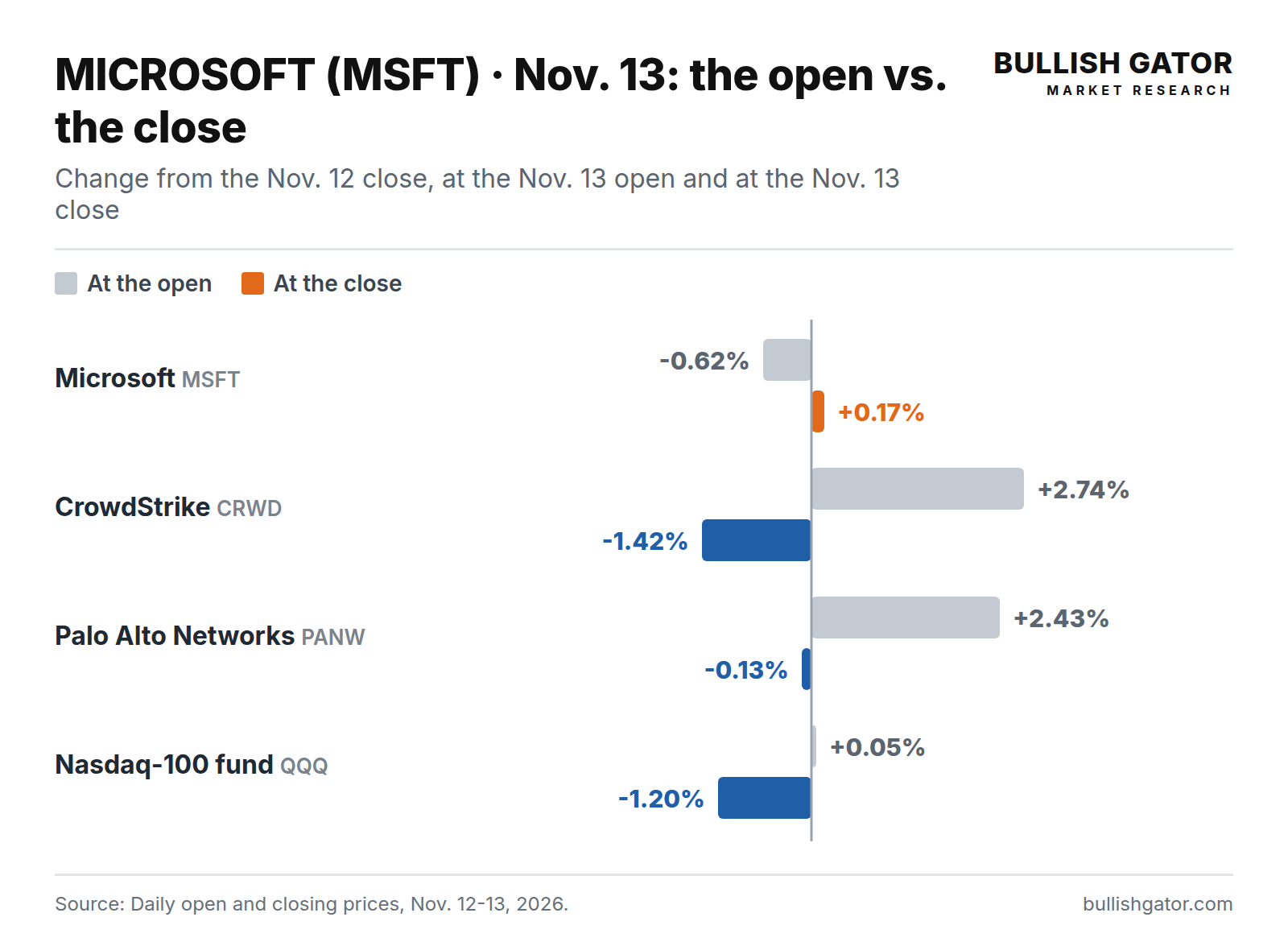
The opening moves ran the way the morning coverage described: Microsoft lower, and CrowdStrike and Palo Alto Networks up on bets that customers would look harder at independent security platforms.6 By the close, every one of those moves had reversed. Microsoft finished higher, CrowdStrike finished down 1.42% and Palo Alto Networks down 0.13%, in a session when QQQ fell 1.20%.5
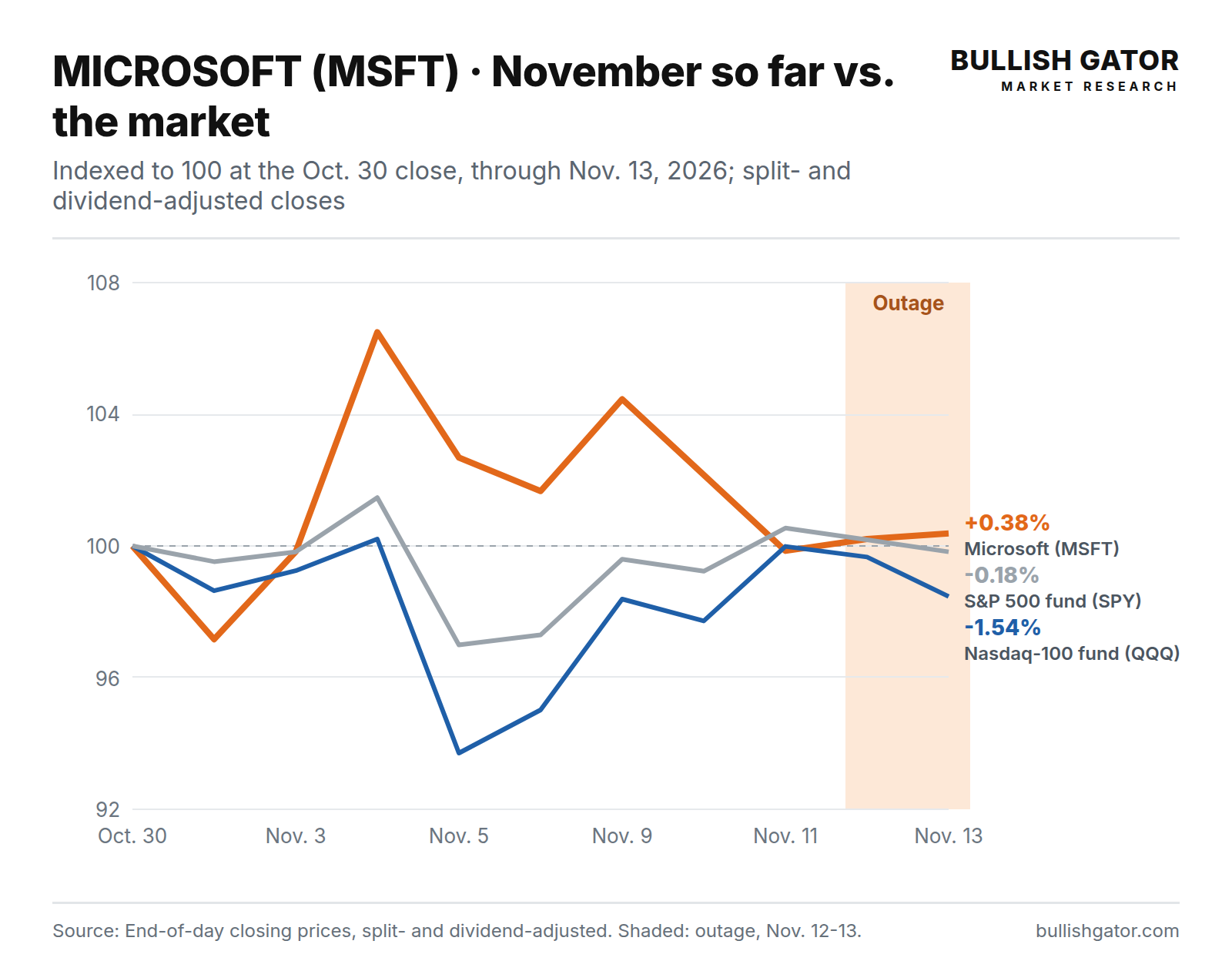
The bigger move came earlier in the month. Microsoft closed at a 52-week high of $555.80 on Nov. 4, then fell 4.41% over Nov. 10 and 11, before the outage began on Nov. 12. On Nov. 13 it stood 5.74% below that high. For the week it was down 1.27%, for the month down 3.60%, and for the year up 9.01%.5 Over five years, $10,000 invested in Microsoft at the Nov. 12, 2021 close would be worth $16,212.64 on Nov. 13, 2026, a 62.13% total return with dividends reinvested, according to Bullish Gator’s Historical Stock Return Calculator.7
How the coverage framed it
Three themes ran through the coverage. The first was Copilot. GuruFocus said the outage “tests its Copilot push,” noting that reliability becomes a selling point as Microsoft asks customers to pay more for premium tools, and that Microsoft 365 commercial cloud revenue grew 17% year over year in the September quarter, helped by offerings including Copilot.4 The second was concentration risk: a Schwab Network segment carried the title “Microsoft Outlook Outages Highlight Cloud Concentration Risk,” and a Simply Wall St analysis said the outage stress-tests whether heavy AI and cloud spending is buying reliability as well as capacity.89
The third was switching costs. The same Simply Wall St piece argued that deep integration of Microsoft’s data and AI tools makes it costly for customers to leave, while a second Simply Wall St article called the outage a reputational issue rather than, so far, a clearly material hit to demand.910 GuruFocus noted it was Microsoft’s second service disruption of the year.3
A separate disruption the same day
On Friday afternoon, the Federal Aviation Administration issued a nationwide ground stop, and flights resumed that evening. The FAA attributed it to its own legacy equipment becoming unstable when data flooded the FAA’s telecommunications network with about 1,000 connection attempts every four to five seconds, and said it had no indication of a cyberattack. The FAA and L3Harris are still investigating the root cause.11 The FAA’s account traces the problem to its own network; Microsoft’s outage and the ground stop are treated here as separate events.
Ignite is the next checkpoint
Microsoft’s Ignite conference for business customers runs Nov. 17 to 20 in San Francisco. CEO Satya Nadella and Judson Althoff, who leads Microsoft’s commercial business, open it with a keynote on Tuesday, Nov. 17, at 10 a.m. Pacific (1 p.m. ET) at Chase Center, and Microsoft has said security is a theme across all four days.1213 The Motley Fool noted that Microsoft did not disclose an updated paid Copilot seat count in its Oct. 28 report, after reporting 15 million seats in January, more than 20 million in April and more than 30 million in July. On the earnings call, CFO Amy Hood said Microsoft instead “talked about momentum in revenue and usage.”12
What investors should watch
- The post-incident report. Microsoft has promised a full review. GuruFocus said details on why the servers failed and what Microsoft is changing will help customers decide whether they need backup systems.14
- Ignite on Nov. 17. Whether Microsoft addresses the outage on stage, and whether it gives an updated paid Copilot seat count.1213
- The next earnings report. GuruFocus pointed to any disclosure of service credits, changes in commercial subscription growth and signs that customers are slowing paid Copilot deployments.4
- Security stocks. Palo Alto Networks reports on Nov. 18, an early chance to hear whether management has seen any change in customer conversations or forward demand for independent security platforms since the outage.6
Sources & methodology
Sources
- BleepingComputer. Massive Microsoft 365 outage disrupts Outlook, Teams, Copilot worldwide. November 12, 2026, with updates through November 13. Source for Microsoft’s incident advisories, recovery updates, Charles Lamanna’s comments and Microsoft’s statement on the cause.
- Yahoo Finance (GuruFocus). Microsoft Stock Drops as Global Outage Cripples Outlook, Teams and Copilot. November 13, 2026.
- Yahoo Finance (GuruFocus). Microsoft Stocks Edge Lower as Outlook and Teams Outage Tops 12 Hours. November 13, 2026.
- Yahoo Finance (GuruFocus). Microsoft Stock Falls as Outage Tests Its Copilot Push. November 13, 2026.
- Tiingo. End-of-day prices for Microsoft, CrowdStrike, Palo Alto Networks, QQQ and SPY. Daily open, high, low and closing prices through November 13, 2026; multi-day changes use split- and dividend-adjusted closes; volume compared with the 20-session average.
- Yahoo Finance. CrowdStrike and Palo Alto Networks Climb 3% as Microsoft Outage Disrupts Outlook and Teams. November 13, 2026. Morning-trading report; closing moves are from end-of-day prices.
- Bullish Gator. Historical Stock Return Calculator. Five-year Microsoft return from the November 12, 2021 close through the November 13, 2026 close, split- and dividend-adjusted, dividends reinvested; November 13, 2021 fell on a Saturday.
- Schwab Network (via Bullish Gator Videos). Microsoft Outlook Outages Highlight Cloud Concentration Risk. November 15, 2026.
- Simply Wall St. What Does Microsoft (MSFT) Global Outage Mean For Its AI Infrastructure Story?. November 14, 2026.
- Simply Wall St. How Investors May Respond To Microsoft (MSFT) Global 365 Outage. November 15, 2026.
- Federal Aviation Administration. Nationwide Ground Stop: Questions and Answers. Primary source for the November 13 ground stop, its stated cause and the cyberattack assessment.
- Yahoo Finance (The Motley Fool). Microsoft Ignite Starts Nov. 17. Will Microsoft Update Its Paid Copilot Seat Count?. November 15, 2026.
- Microsoft. Secure what’s next: Your guide to Microsoft Security at Microsoft Ignite 2026. Primary source for the November 17 keynote time, venue and speakers.